what burning fossil fuels does to the environment
The apply of fossil fuels—coal, oil, and natural gas—results in significant climate, environmental, and health costs that are not reflected in marketplace prices. These costs are known every bit externalities. Each stage of the fossil fuel supply concatenation, from extraction and transportation to refining and called-for, generates externalities. This fact sheet provides a survey of some of the externalities associated with fossil fuels.
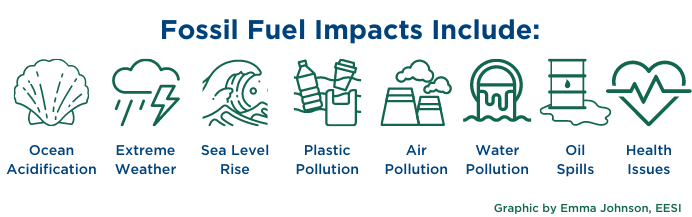
Climate Externalities
When fossil fuels are burned, they emit greenhouse gases like carbon dioxide that trap oestrus in the earth's atmosphere and contribute to climatic change. In 2019, fossil fuels accounted for 74 percent of U.South. greenhouse gas emissions. Nearly 25 percent of emissions in the U.s.a. come up from fossil fuels extracted from public lands. Some of the climate externalities of fossil fuels include:
- Sea acidification: At least a quarter of the carbon dioxide emitted from fossil fuels is absorbed by the sea, irresolute its chemical science (pH). The increased acidity makes it harder for marine organisms to build shells and coral skeletons. Over the last 150 years, sea acidity has increased by thirty percent, posing threats to coral reefs, fishing, tourism, and the economic system.
- Farthermost weather: Co-ordinate to the National Oceanic and Atmospheric Administration, climate change, brought upon past burning fossil fuels, is contributing to more frequent and severe extreme weather events that lead to disasters costing at least a billion dollars each. The price of extreme conditions events, including wildfires, hurricanes, wind storms, flooding, and droughts, between 2016 and 2020 in the United States has been estimated at $606.nine billion.
- Sea level rise: Oceanic and atmospheric warming due to climate modify is melting glaciers and land-based ice sheets, resulting in global sea level ascent. Sea levels take risen most 9 inches since the belatedly 1800s, causing more frequent flooding, destructive storm surges, and saltwater intrusion. With 40 percent of the U.S. population living forth the coasts, it is estimated that defending littoral communities from ocean level rise could toll $400 billion over the adjacent xx years.
Environmental Externalities
Fossil fuels have significant environmental externalities including:
- Air pollution: Fossil fuels produce chancy air pollutants, including sulfur dioxide, nitrogen oxides, particulate matter, carbon monoxide, and mercury, all of which are harmful to the environment and human wellness (every bit discussed in the health section below). Air pollution from fossil fuels can cause acrid rain, eutrophication (excessive nutrients that can impairment aquatic ecosystems by lowering oxygen levels), harm to crops and forests, and harm to wildlife.
- H2o pollution: From oil spills to fracking fluids, fossil fuels cause water pollution. Each fracking well uses between 1.five 1000000 to 16 meg gallons of water, and the resulting wastewater can be toxic, often containing substances like arsenic, atomic number 82, chlorine, and mercury that can contaminate groundwater and drinking water.
- Plastic pollution: Over 99 percent of plastics are made from fossil fuels. Globally, 300 million tons of plastic waste matter are produced each year, fourteen million tons of which end up in the sea, killing wild animals and polluting the food concatenation. Plastics also have climate consequences: the U.S. plastic industry produces 232 million tons of carbon dioxide equivalent per year, and the industry'southward greenhouse gas emissions are expected to surpass those of coal-fired power plants by 2030.
- Oil spills: Fossil fuel extraction, transportation, and refining can atomic number 82 to oil spills that damage communities and wildlife, destroy habitats, erode shorelines, and outcome in beach, park, and fishery closures. The largest oil spill in history, the 2010 BP Deepwater Horizon spill, released 134 million gallons of oil into the Gulf of Mexico, killing 11 people and countless birds, turtles, fish, marine mammals, and plants—and toll BP $65 billion in penalties and cleanup costs.
Health Externalities
Air pollution from burning fossil fuels tin cause multiple health issues, including asthma, cancer, heart illness, and premature death. Combusting the additives found in gasoline—benzene, toluene, ethylbenzene, xylene—produces cancer-causing ultra-fine particles and aromatic hydrocarbons. Globally, fossil fuel pollution is responsible for one in five deaths. In the U.s.a., 350,000 premature deaths in 2018 were attributed to fossil fuel-related pollution, with the highest number of deaths per capita in states similar Pennsylvania, Ohio, and West Virginia. The annual toll of the health impacts of fossil fuel-generated electricity in the United States is estimated to exist upward to $886.v billion.
The ecology and health impacts of fossil fuels disproportionately harm communities of color and low-income communities. Blackness and Hispanic Americans are exposed to 56 and 63 pct more than particulate matter pollution, respectively, than they produce. In a predominantly Blackness and low-income area of Louisiana known equally "Cancer Alley," the cancer take chances is nearly 50 times college than the national average due to 150 nearby chemical plants and oil refineries.
Policy Mechanisms to Reduce Fossil Fuel Externalities
Several policy mechanisms have been proposed to reduce fossil fuel externalities, including:
- Eliminating fossil fuel subsidies, which could generate $35 billion in taxpayer savings over the next ten years. To learn more about policy mechanisms to phase out fossil fuel subsidies, bank check out EESI's fact sheet.
- Increasing the social cost of carbon (SCC), which estimates the often-uncounted economic damages that result from carbon dioxide emissions. The federal government uses SCC to evaluate the climate impacts of policies.
- A federal clean electricity standard, which would crave a percentage of the electricity sold by utilities to come from clean electricity sources. Such standards already exist in several states and normally require the share of clean energy on the electric grid to increase over time.
- A carbon toll, which sets a cost on carbon dioxide emissions that is paid past emitters. Carbon price policies can be structured in different ways, including equally a carbon taxation. Cap-and-trade programs like the Northeast's Regional Greenhouse Gas Initiative, in which the market determines a carbon price, accept existed at the subnational level for many years, reducing emissions and creating new revenue streams for clean energy investments.
Author: Savannah Bertrand
Editor: Anna McGinn
Graphic: Emma Johnson
For the endnotes, delight download the PDF version of this issue brief.
Source: https://www.eesi.org/papers/view/fact-sheet-climate-environmental-and-health-impacts-of-fossil-fuels-2021
0 Response to "what burning fossil fuels does to the environment"
Post a Comment